Franklin Square
The Lost SymbolFranklin Square is a historic park in northwest downtown Washington, bordered by K Street and Thirteenth Street. In the novel, its name becomes the hinge between two competing readings of the Masonic pyramid: a literal location where a hidden secret might be found, and a mathematical instruction that reveals how to read the pyramid’s final cipher. The resulting confusion draws the Central Intelligence Agency into an elaborate attempted interception while the true clue points beyond the square’s apparent geography.
Setting and Historic Character
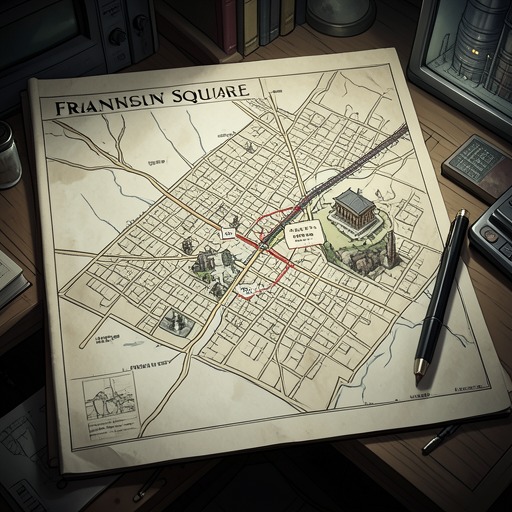
Franklin Square occupies a full block in the northwest quadrant of downtown Washington. The surrounding area contains historic buildings, including the Franklin School, associated with Alexander Graham Bell’s transmission of the world’s first wireless message in 1880. The square is therefore presented as a place layered with civic history, but its importance to the immediate plot comes from the tension between a recognizable urban landmark and an address that cannot be found.
The park itself offers a different kind of setting from the streets and buildings around it. From the roof of One Franklin Square, Inoue Sato looks down on a rectangular, wooded space that fills the block. The trees provide cover for agents, but they also make the park a place where people can disappear from view. At night, Warren Bellamy is left pacing and shivering beneath a streetlamp in a clearing, visible enough to serve as bait and exposed enough to underscore the danger of the plan.
The most striking building associated with the square is the Almas Shrine Temple. Seen from the park, its Moorish-style facade stands between two larger buildings, faced with gleaming, multicolored terra-cotta tile. Three massive doors and two tiers of lancet windows give it an appearance unlike the surrounding offices. Its architecture makes the site seem at once conspicuous and concealed: a distinctive structure in the middle of downtown that the agents charged with watching the square initially do not recognize.
The Apparent Address
The words revealed on the pyramid’s capstone send Robert Langdon and Katherine Solomon toward an apparent destination: Eight Franklin Square. The discovery arrives with urgency. They have deciphered the pyramid and possess information that could help them negotiate for Peter Solomon’s release, while the glowing hands of Langdon’s watch show that they have less than ten minutes. Yet the address is puzzling even to Langdon, who knows Franklin Square as an old part of Washington but does not know what might be found at the stated number.
The phrase also misleads the Central Intelligence Agency. Inoue Sato is already positioned on the roof of One Franklin Square, intending to have her agents intercept their target without alerting him. The building’s name sounds as though it should confirm the existence of Eight Franklin Square, but it is a building name, not a numbered street address; its actual address is 1301 K Street. When Nola Kaye checks, she finds that Eight Franklin Square does not exist as a Washington address. The mismatch turns what seemed to be a precise instruction into a problem of interpretation.
Sato’s team nevertheless has a physical landmark to investigate. Turner Simkins, concealed in the wooded park, follows Sato’s direction and spots the Almas Shrine Temple. Once she identifies it, the building suggests a possible answer to the phrase’s reference to an order. It is the headquarters of the Ancient Arabic Order of Nobles of the Mystic Shrine, an appendant body of the Masons more commonly known as the Shriners. The connection appears plausible enough to reshape the surveillance operation, although the temple is not the solution to the cipher.
A Park Turned into an Interception Zone
The Central Intelligence Agency’s plan converts the square from a historic public space into a concealed waiting ground. A helicopter makes a brief rooftop landing at One Franklin Square, dropping off the field team before lifting away to provide support from above. The agents then escort Bellamy down to the park and place him alone in a clearing. Sato remains on the roof, waiting for calls from Nola and from the agent sent to Kalorama Heights, while her team blends into the natural cover below.
The operation depends on the target approaching without sensing that the square is watched. Sato knows that if he detects the team, he may simply disappear. Bellamy’s role as bait makes the park’s openness and concealment work together: the streetlamp keeps him in sight, while the surrounding darkness and foliage hide the agents. When Simkins later shifts his attention from Bellamy to the temple, surveillance expands from a person in the clearing to a building that might embody the Order named by the clue. The square thus becomes the setting for two parallel acts of interpretation: the agents try to identify the place, while the pyramid’s wording still has to be understood.
The Mathematical Resolution
The decisive correction comes when Mal’akh reconstructs what Langdon shouted while trapped in the liquid-breathing chamber. The phrase is not a demand to go to a numbered address. It directs him to an order-eight magic square. In this reading, “order” names the size of the mathematical grid, and “Franklin” identifies Benjamin Franklin, whose famous eight-by-eight square arranges the numbers one through sixty-four so that every row, column, and diagonal has the same sum.
That distinction changes the function of Franklin Square in the puzzle. The apparent place-name has led Sato’s agents toward a real square and a plausible secret order, but its decisive words instead specify a method for rearranging the sixty-four symbols on the pyramid’s base. Franklin Square remains important as a carefully constructed false geographic trail: the wording invites a search through streets and buildings before it yields to numerical structure. The park’s role in the story is therefore not simply to house a possible hidden entrance. It stages the gap between seeing a clue as a destination and recognizing it as an instruction.